Showing posts with label conceptual research. Show all posts

Monday, June 13, 2011

Zidane: A 21st Century Portrait

During the course of this project I have been directed, several times, to the work by Douglas Gordon Zidane: A 21st Century Portrait. The French art critic Philippe Parreno, with whom Gordon collaborated, described the intent behind the work as being to "make a feature film which follows the main protagonist of a story, without telling the story." According from the blog where I sourced this quote, it's about portraiture, and possibly narrative too, a claim I can support after watching snippets of it on Youtube (such as the clip below).


Seeing as my work can be read as a series of video portraits of extended length, it's quite possible that it may explore similar artistic territory as Gordon and Parreno's. However, it is impossible to evaluate the work without first considering that it was filmed by, in the words of blogger Dan Hill, " the best camera operators in US and Europe", using a mass of absurdly expensive, military-grade video equipment, and the subject is one of the world's most famous sports celebrities. I, on the other hand, used the facilities available to me and my subjects were people I know who expressed interest in the project. There are many differences you could list:
  • As previously mentioned, this work is constructed on ideals - ideals of wealth. It may be a comment on then, but would it be any less of one if the filmmakers had spent half the money they had to make it? My work is very much opposed to ideals. As I wrote in my proposal it's a take on a contemporary realism of sorts.
  • Part of this realism is based on honesty to the viewer, the visual documentation of perceived reality as opposed to manipulative cinematic techniques. This artwork has soft, acoustic elevator rock playing in the background. Why? To make it look and sound even more like an advertisement? It's certainly not an audio signify we're meant to consider consciously.
But the work is about repetitive actions - most of it seems to consist of Zidane running, and then slowing to a walk, then running again. And my work does document repetitive actions. But mine doesn't need a soft rock backing track to make it interesting to the viewer, they are allowed to consider the repetition how they will and find it interest in its representation, I won't force them beyond basic editing.

Sunday, June 12, 2011

If I were to film someone I didn't like

I would probably produce a good art work. I think this is close to unarguable. That isn't to say that the footage of Alex and Sean, who I both like, hasn't translated into good art - on the contrary, the finished videos are some of my best, most developed work, in no small part to the amount of time I put into filming and editing them. But it seems as if I wouldn't even have to try if I were to film someone who pissed me off, my subconscious would take over many of the technical aspects of filming and give my conscious time to ruminate on the undesirable characteristics of his or her character.

How I would come across someone I don't like who would also let me film them is where this idea loses footing. I know very few people I dislike, and fewer still I would be willing to approach creatively. Instead, the ideal method of finding someone who fits this profile seems to be approaching someone through another subject who I don't know and grow to dislike them while filming them. But then it becomes roulette - I may well find nothing to complain about in the unknown subject, and so will then be indebted to editing their footage respectfully in post-production. And respect is a very unforgiving commitment to make while making films about people. I tell myself that I have only followed them with the camera as they have moved, left it on them as they stand or sit, and zoomed to emphasise a detail they have drawn attention to, and this is entirely truthful.

And, to continue being truthful, I wouldn't be able to change this approach without changing the stated aim of the project. But does the subject determining the content mean that their actions determine the meaning of the film, or do their actions cause a reaction from me and that determines the course of the film? I haven't yet been able to answer this, and I don't want to create an artwork in fear of - fear. I make artwork, often, as an answer to fear, a way of understanding it and avoiding it. Not to immerse myself in it, using it as an appliance. That drains creativity, and for that reason it is perhaps very easily explanable why many artists favour a peripheral vantage point over confrontation.

More on quick shots/long takes


There have been two distinct reactions to the editing in the beginning of Sean's video: it was engaging, versus it was amateur. The seminarian who looked at my work professed an appreciation of longer, lingering shots, and while I am also a fan of contemplative cinematography I decided to edit Sean's morning routine in quick succession and with a certain disjointedness between each shot to further illustrate his rather rigidly sequential nature. However, in order to accomodate a cross-examination of a more lingering, illustrative sequence of shots versus faster, more pronounced editing, I have edited Alex's video with many more long takes and drawn out scenes than I allowed for Sean (or at least the earlier part of his day). This also corresponds to the less linear and sequential, extended monologuing qualities that define Alex's work in relation to Sean's, and in a sense I have found it exposes a certain drama in the proceedings that is itself drawn out and prolonged seemingly indefinitely, similar to Nuri Bilge Ceylan's use of long takes in Uc Maymun.

Still from Uc Maymun. (Source: http://www.europeanfilmacademy.org/2008/10/10/uc-maymun-three-monkeys/ )


Alex soldering jewellery in preparation for a core assessment.

Saturday, June 11, 2011

Future projects

Given the facilities, I think I'll continue to film people for art. But, as I've described before, I feel the creative challenge of extensive filming has been exhausted, and a new format could possibly involve filming individuals for exactly one hour of the day (and perhaps condensing each hour down to a set amount - ten minutes, five minutes?), and showing these hours sequentially. Although it's just an idea at this point.

Performance

Editing Alex's footage, I've found individual variation contributes vastly to the scope of this project. Perhaps due in part to her having taken acting classes, Alex, whether consciously or subconsciously, treated her role in the project as something of a performance - in stark contrast to Sean's preferred realist, documentary approach. While Sean forced himself, as he himself said, to behave as honestly to his own sense of normal behaviour as possible, Alex was, in the words of another viewer, very careful. She had never explicitly described the direction she wanted to take the project in, even on the day quite eager to leave everything to chance.

In a sense, this affects the variety of engagement between herself and the viewer, offering more of a challenge in her handling of chance and taking a more active role in negotiating the camera. She chooses, on several occasions, to deliberately show self-consciousness, even describing it. She also asked me questions as often as I asked her, bringing my own life beyond the camera and the project into the fold and introducing a quality of self-reflexivity to the work, as well as a further challenge presented to me during the editing stage.

Sean had conventions in mind, and to him rules governed, or at least regulated, the use of a camera in any setting in order to produce a desired output. Alex's experience as an actor, however, encouraged her to focus less on the rules of being filmed and more on her own subjectivity and its digital decription. I can only imagine that I would find another entirely unique angle, and therein another creative challenge, were I able to film another individual. But the technical creative challenge of physically filming somebody for an extended period of time has been mostly resolved - I understand the prerequisites, the commitment needed and how art can be formed from it. If I were to film people in the few it may well involve further segmentation and focus on the subject and their relationship with the camera and their environment, as well as with themselves and other people.

Friday, June 10, 2011

Quick takes

I've noticed that small takes can be used to instantiate meaning with a degree of precision not available to longer takes. At the end of the shot, the transition to the next, you're still aware of its beginning, allowing a clearly mental image of wholeness to emerge in your mind following its passing. It becomes something like a statement, and this method of applicaiton works especially well with non-verbal scenes.

Monday, June 6, 2011

Boringness

A popular sentiment about the content of my work is that the vast majority of my footage must be painstakingly boring, by virtue of it being an uninterrupted, rather lengthy recording of observed reality. This is usually made clear in conjunction with some sympathy for my having to spend some time sifting through the assumed boringness for hidden nuggets of the profoundly interesting. But if reality were really boring enough to elicit comment, why do the majority of people manage to continue living within it while only occasionally voicing dissent? Only the most restless, overstimulated addict will yell to all those willing to listen "this is so boring!" while going about their daily routine - most will either remain quietly content in their disinterest or physically apply themselves to the given task in such a way as to find something within it conducive to amusement.

I have observed similar reactions to the screening of my work. Some took active interest in individual components, others remained passively uninvolved - but boredom was, as far as I could tell, a minority sentiment. Putting aside the mild conceit implied in holding this assumption, it is also not as if I actively engendered entertainment in the editing process, by only selecting snippets of unusual or abnormal activity and stringing them together in a sort of artificial composite. Quite the contrary, many of the more popular (not necessarily in a positive sense) scenes were those one would assume to be deafeningly boring, mundane-in-the-extreme colloquialisms of dredged lived experience. An extended shot of Sean fastidiously (perhaps even anally) eliminating evidence of spilled coffee elicited comment from no less than three separate people watching it, judgemental tones akimbo. What does this say about how we watch and what we want to watch? Certainly it's a rejection of the Hollywood ethos of manipulation through stimulation, or at least a counter to it. I assume identification has something to say about its effect, although while we may use identification to navigate a video work, subconsciously it operates in an entirely different manner, and not one I feel competent enough to analyse in detail.

Monday, May 30, 2011

Display

Two immediate options come to mind with regards to displaying this work - TV/monitors and projection. I need to test both out first, but I'm leaning towards having the two works on self contained monitors or television screens for both conceptual and more pragmatic concerns.

Conceptually, the work is in some ways an interrogation of the way in visual media is increasingly doctored to manipulate and put the viewer ease - to operate on a subconscious, less consensual plane. A television screen invites the viewer to focus and engage, to involve themselves in a way similar to how they would involve themselves in a book, in the manner of the more traditional, education-based programming of television networks before the focus-group culture took hold. A projection signifies immersion, is meant to encourage it, and this may well work as counter-intuitive to the some of the core ideas behind my work.

Technically, the video quality of the work, especially Sean's piece, is grainy even on a small screen and I worry a large-scale projection may magnify its flaws. But the fine details go some way in making the work, and these will be, at least partially, lost in the lack of definition one finds in a projected film. It may work effectively in a dark room, but I'm presenting my photographic Visual Research work in the same space so decent lighting is a must.

I'll need to test both options once I have a finished work, but I have preferences in mind.

Monday, May 9, 2011

Feedback and editing


Of the many points of view given in feedback after I presented, a few stand out as being particularly stressed:
  • The relationship between the viewer and the subject was mentioned more than a few times, specifically the identification with certain aspects of Sean's morning routine and the comparisons that can be made between him and the viewer, as well as him and Alex. Certainly I appreciate any engagement made, although I don't try to forcefully engineer such an engagement in either the shooting or the post-production. But if people find an academic interest in his life and how he applies himself to various situations then I will try to present the video in such a way that it can be, as easily as possible, interpreted and regarded openly with reference to the life of the viewer and that of other subjects.
Sean's conservative breakfast spread of only two Weetabix was remarked upon as being particularly meagre by some, perhaps effecting a judgement upon his identity as relative to his subscription to the national corporate character.

  • Susanna Castleden raised the possibility of my reflection on the work and the decision making process I undergo being incorporated into the work itself, perhaps through voice-over, a term I let slip in disparagement. I feel, instinctively, that it would interfere with my stated aim to provide information for the viewer to interpret, with the arrangement of the isolated samples of the video my main editing creative contribute. But Global Village, one of my inspirations for the project, has Silvio Rivier's voice of reason politely informing the events unfolding on screen without interfering with them, so perhaps part of my prejudice needs to be challenged.
  • Susanna also mentioned Tracey Moffat's series of women fighting back in film, which sounds like a very interesting exercise in editing, especially the dramatic qualities of separate clips from hundreds of films across a common theme and sequencing them.
  • The number of people I'm going to film could be kept at two or expanded to four. If I keep it at two, I received the general impression, which I'm very content with, that the footage I have so far stands on its own and it's possible to engage by editing and displaying it alone. But filming more people could further the number of potential comparisons and relationships, expanding the size of the proverbial canvas for both myself and the viewer. Which I suppose makes it a question of workload.

Monday, May 2, 2011

The tagging system and Jo Richardson

After consultation with artist Jo Richardson during a seminar, I have begun work on a tagging system in presenting my video for my final review. This will involve isolating several clips from all the footage I have based on certain very tangible concepts - 'eating', 'washing', 'coffee', 'self-reflex' (recognition of the camera), 'abject', etc. I will then organise an installation where these keywords can be selected by the reviewers, and all the associated videos will be played immediately across a series of screens. This will, for the moment, work in conjunction with a playing sample of the finished documentary (if it is finished). Also, I would like to setup one computer so that the reviewers can peruse a time-signified collection of all the footage I have taken, functioning both as documentation and an artwork in and of itself. The challenges facing me are:
  • Learning the software which will allow this (I'll ask Kev about software I've used for similar projects involving much more interactive video before and if it's appropriate).
  • Defining a series of appropriate tags and isolating individual video clips appropriate to them.
  • Determining how much computer monitors the installation will necessitate, how the computer or computers will communicate the videos to them and how this will figure in the total number of clips (perhaps a monitor per subject).
Jo also suggested that the footage I've taken of Sean should be enough, if need be, to flesh out a finished body of work for the review, which is somewhat reassuring. The possibility of accompanying stills was also raised, and I have a few in mind which are deserving of printing.

Sunday, May 1, 2011

Two subjects and Chloe Hughes

At the moment I have two possible subjects I haven't got around to filming yet, but I hope to next week. They are the aforementioned Alex, a jewellery student and waitress, and Lachlan, an engineering student and hockey enthusiast. Ideally, I'd like to film them within the coming week, and I'm also throwing around the idea of bending the rules of the project a little to accomodate multiple sessions to cover an entire day. This may be especially relevant in the case of Sean, who's schedule is allowing of such practices.

I also saw Chloe Hughes's work at PICA, Structures to move to (conversations on work), which is similar to my work in the sense that both are documentaries of sorts, focusing on multiple individuals and their working environments. However, the most I can take from her work in terms of inspiration is justification for not prioritizing the audio in my piece. I found the monologues vaguely insightful, but almost without exception excruciatingly self-revolving and inwardly turned. Her work would have perhaps benefited from a small button placed next to the projection that, when pressed, mutes the video, and I was searching for this button within 5 minutes of sitting down. The claustrophobia may have intentional, but even if it was it completely contradicted any possible engagement with the work. I may then rely on a fixed standard of much video art and let the visuals say more than the audio.

Saturday, March 12, 2011

Contemplating whether to film again and Mark Laita

After 11 hours, I decided I wanted to stop filming Sean and go home. This was mostly because I had spent long enough filming to realise what I had done right and what needed to be changed the next time, but attrition also came into it. The question remains whether I will try re-filming him, and I need to ask Sean about this. Certainly, as he pointed out, a significant portion of his day - the evening - wasn't filmed, and this, quite apart from his rather social day job, casts him in a rather more solitary light, where he spends much of free time watching television, playing his guitar and trading securities. He offered at the end of filming to be available for another day so I could film his evening as well, although we didn't discuss filming his day again.

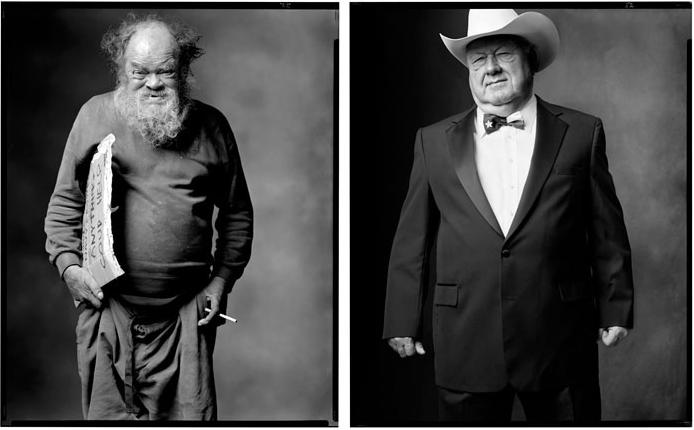
Via thesocietypages.com, I have come across a contemporary photographer who explores similar territory - one Mark Laita. According to his artist statement, his work revolves around the "growing chasm" in American society between rich and poor, and as such he contasts portrait photographs of people on different economic strands of society but with very clearly defined connections across a spectrum. Juxtapositions such as a homeless man versus a real estate developer (pictured below) work to counter presented ideals and cultural icons with the reality of of their role in society and the relationships they share with their polar opposites.

My project is similarly concerned with the tangible spheres of influence individuals occupy within society, but as my work is in video format it is intended as more of an exercise in documenting a period of living, rather than the presentation of a particular image.


Source: http://thesocietypages.org/socimages/2011/02/21/social-commentary-through-juxtaposition-the-work-of-mark-laita/